
Death Howl is Hauntingly Beautiful, Yet Frustratingly Flawed


A soulslike with tactical turn-based combat and deckbuilding sounds like way too much, but developer The Outer Zone dared to dream big. I used to be a big proponent of the idea that if you add too many elements to a game, you just end up with a game with a bunch of mediocre parts. I don’t feel that way anymore. In fact, I’m excited how developers these days come up with clever ways to bend and break gameplay rules. It’s an entire gaming renaissance that is barely acknowledged. But great concepts, even if realized, aren’t always executed perfectly.
Death Howl is a game I was initially wary of, but then fell in love with. The gorgeous, dreamily haunting pixel art mixed with a novel and engaging combination of gameplay mechanics hooked me right away. You play as Ro, a grieving mother who refuses to accept the death of her son. Instead, she goes into the spirit world to fight her way to him in an effort to bring him back. I’ve always appreciated the types of stories where you kill gods, or fight your way through hell–so Death Howl’s premise is something I definitely could get behind. Mix that with a folklore-steeped Scandinavian purgatory and you get a game that feels like a lost legend, one that balances the cosmic scale of defying the afterlife with the intimate, crushing weight of personal grief.

As Ro, you explore this spirit world and encounter strange creatures, uncover secrets hidden in the map, loot items, and run into grid-based combat encounters. There are many benefits to exploring the world–not just for items that you can use to craft new cards, but also quests that give you unique cards as rewards, and other items you can find to help your quest.
If you accidentally walk into combat, you can initially cancel with no penalty, but once combat progresses there’s no going back–and there’s no “undo” button in combat, either. Any misclick can lead to the end of that combat encounter. I failed often, but I took the ‘git gud’ approach to Death Howl’s combat encounters–only to realize that I wasn’t getting the same return on investment ratio I was getting with Dark Souls–so to speak.
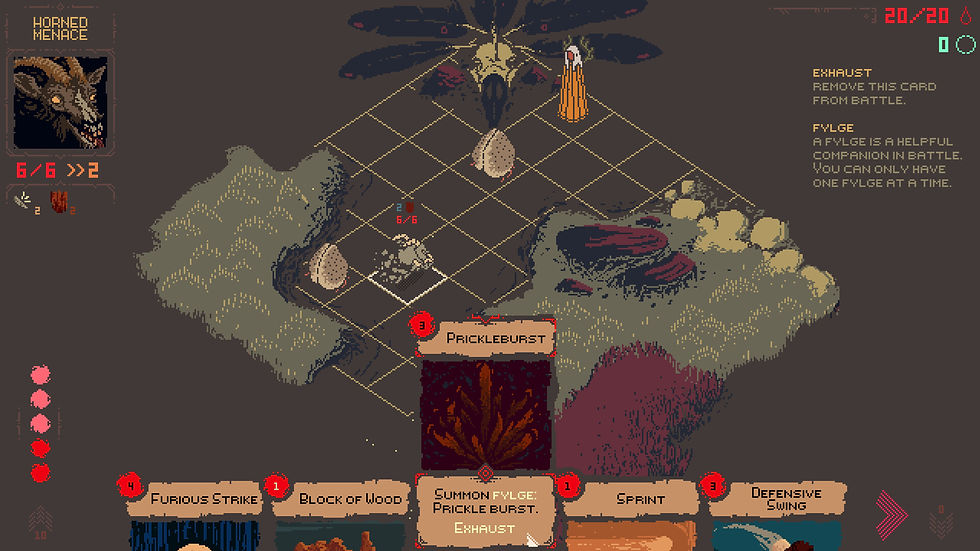
Since there are no movesets to memorize, or weapons to learn the feel for, improvement in Death Howl means trying different combinations of cards in your 20 hand deck, and seeing what works and what doesn’t. Unless you’re a deckbuilding savant (I’m not) Death Howl can feel a bit frustrating. I remember what it was like as a kid trying to play other kids with my crappy Magic: The Gathering deck–because that’s all I had. Death Howl allows you to craft new cards to help fill in any tactical gaps you might have.
Battles take place on a grid. I would have preferred hex-based, but Death Howl at least avoids the pitfall of always punishing movement or always punishing turtling by having a variety of enemies to fight–healers, those with one touch kills, ranged, melee, and more. Combat is turn-based, with movement and abilities enabled by spending mana. Each region has its own set of unique cards, which allows you to build and try multiple different decks during your playthrough. But that’s also one of my biggest gripes with Death Howl.

It really feels like Death Howl doesn’t respect your time, or even your preferences. If you find a fun weapon in Dark Souls, it might not be viable for the entire game (though more often than not it would be) but you wouldn’t be outright penalized for using it in a different area of the game. In Death Howl, any regional cards are penalized by costing more mana. Further, any other ability upgrades–like totems, which enable much needed bonuses–are undone for any new region you enter, forcing you to level up a whole new set of bonuses that are region specific.
And it’s around the time I realized this fact when the honeymoon period wore off. That’s when I just had to grit my teeth and get into the grind. It was like I had to learn to love it for what it was, not what I wanted it to be. Though I still feel like it might be a better game if it didn't punish the player for progression.

But there are other ways that Death Howl gives players a break. You can fast travel between this game’s bonfire equivalent (called ‘stone circles) as long as you aren’t holding a quest item. If you die, you lose whatever experience you’re carrying just as you would expect–but you’re not forced to fight through every group of enemies again. Instead, you’ll start the fight with the same health as you did when you originally started the encounter. This is pretty forgiving, but it also led to me throwing myself against the wall until I finally got the perfect RNG to get through the fight.
I played Death Howl on my Steam Deck for the majority of my playtime–and while it runs great, I ran into a fair number of bugs that didn’t let me select cards properly while playing with my Steam Deck docked, leading to a lot of frustration. I hope these bugs are fixed on a Day One patch, otherwise you might have to undock your Steam Deck to get past the issue before you can redock it.

Death Howl is a unique game. It has a brilliant core concept with some strange design decisions that make it feel like a bit of a grind when it really doesn’t have to be. But I do love it for what it is. When my deck works the way I want it to, Death Howl is great fun. Despite the bugs and baffling design choices, this is the most fun I’ve had with a deckbuilder since I first played Slay the Spire.
Death Howl is out December 9th on Steam and GoG, and will be coming next year on consoles with a physical edition confirmed for Q1 2026.


Comments