
We All Float Down Here, but the Joffrey Soars with Depression Era Tragedy "Liliom"


I don’t like to live in extremes. Especially as a reviewer, things that fall too far towards a total loss are hard to write about - because it’s not always as clean cut as there being no effort put in, and no thought. Sometimes it’s a lack of understanding or a leap too far left of center. Swing the other way, and something that you can’t really find fault with leads to a big ol’ case of writer’s block and oftentimes, can seem like pandering. There’s a reason for shades of grey. Even still, extremes are enticing. When you see something incredible, you tell everyone. When you taste something horrible, you call someone over to share the experience with you.
I’m not going to keep you in suspense here, not that you necessarily were in suspense if you have any familiarity at all with John Neumeier or the Joffrey Ballet as a whole. From top to toe, they’re masters of their craft and Liliom is absolutely a reflection of that. It’s a masterpiece. It transcends. It’s stunningly, breathtakingly beautiful and absolutely heartbreakingly tragic.
It’s more than a ballet but absolutely a ballet. The Joffrey Ballet’s Liliom fully embodies the original work but also extends its borders. And none of it would be as compelling to the core if every single part of Liliom wasn’t conceived, choreographed, lit, costumed, scored or danced as perfectly as it is.
That intensity sets it on fire in the best way. Extremes are born of passion, and passion for better or worse is at the heart of Liliom’s story. If you, like me, were unfamiliar with the original 1909 play by Ferenc Molnar, and also, simultaneously unaware of the musical it inspired, Carousel, it’s putting it lightly to say it’s a tragedy. Set during the Depression in a city “very much like Chicago” it centers around a charismatic carnival barker going through a sort of Dickensian series of flashbacks of his life - why it ended, why it began, and actions he should or should not have taken.
Setting the scene at the Lyric, the curtains were already drawn aside to reveal a window to the sky as we found our seats. In a theater as ornate on such an important evening, it almost seems like a tear in the fabric of reality to see the jagged edges of the backdrop give way to a bright blue sky with fluffy white clouds. And it’s a great glimpse of what’s to come before the baton drops on the first song.
Liliom isn’t even our main character’s name, and even in the play, he hardly has one. It’s in fact the Hungarian word for lily (yes, like the flower) and it’s one of those monikers you get by being the opposite of the thing the word describes. In this case, being called a lily - something white, pure and delicate - is a juxtaposition to what you really are if you earn that nickname - a tough guy.
One of the most interesting choices Neumeier made in the adaptation of the play to the ballet was to change the gender of Liliom’s child from a daughter to a son, and introduce a theme of generational trauma and masculine identity to the mix.
While you’d be forgiven for thinking that a play that takes place in an amusement park that inspired a movie that had a name like Carousel would be all cotton candy and whimsy, Liliom takes that notion from you immediately with its first act, and the introduction of the Balloon Man. Now if I’d known any of that, or if I’d read the synopsis inside the program before I started taking notes, I wouldn’t have had the unique experience of solely interpreting the story through what I saw on stage. It was a decision made out of necessity (and anxiety) that turned out to be rewarding in a strange way - I only had the ballet to tell me the whole story.
As a journalist it’s not something I admit with any sort of pride - doing the research is crucial. But it lent itself to the discovery that the entire company at Joffrey is capable of telling the story of Liliom without the benefit of words, and with the virtuosic talent of everyone involved.
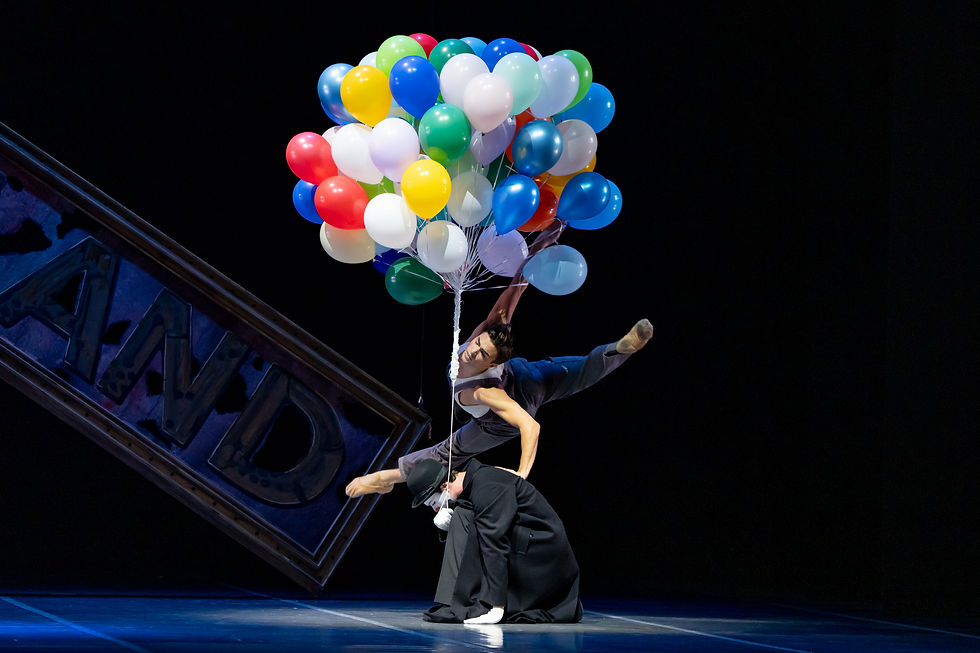
As the lights dim and the show starts, Balloon Man (who I’d simply referred to as Sad Clown in my notes) begins a slow and eerie solo journey from one dark corner of the stage to the other, a rainbow of perfectly glossy and buoyant balloons at times seeming to lift him, drag him, and tie him to his place. And he is a sad clown, quite literally, with a defeated, depressed greasepaint ghost of a grimace. He’s a clown. He should be happy. A lighter-than-air, candy colored array of balloons should be uplifting. But it isn’t, and his presence is instead a constant reminder that the other side of comedy is tragedy. I mean, hope floats, perhaps, but what happens if nothing else does?
Liliom’s Balloon man, Evan Boersma, becomes a sort of River Styx tour guide, leading Liliom the man, through the afterlife, and the life he led before.
It begins and ends with the amusement park, and everything about Ferdinand Wogerbauer’s set design, Jim French and John Neumeier’s lighting design, and Michael LeGrand’s scoring creates the perfect illustrated page for the Joffrey’s dancers to leap off of. It’s a feast of neon ferris wheel silhouettes, bright lights and the centerpiece carousel. But it’s no happiest place on Earth nor is it in its prime, and everything has the patina of diesel smoke, street trash and rancid puddles of a city that’s under the constant strain of economic depression. Playland’s sign is askew and in disrepair directly behind the gilded reins of ornate horses and other such tamed exotics waiting to take you away from reality and into a swaying, soothing spin or two around the circle.

Crowds rush in, pointing, laughing - falling in love. Balloons are everywhere in Liliom’s imagery, and to me seemed a direct representation of hope and its fleeting nature. Almost everyone could have it, but it rarely stayed with anyone for long, and the longer the play went on, the harder it was to obtain or keep.
Liliom is the sort to have a lot of dates but never be dating, and he’s also the sort who’s seduced by fame and fortune. He’s got the talent and especially the charisma to win over crowds, and entice them to come in, but he’s also short tempered, impulsive and chronically emotionally unavailable. Which of course, makes him the sort who’s absolutely irresistible. A classic ‘bad boy’ (tough guy?) who oozes confidence but has never heard of caution.
You get to know his character right away thanks to the bombastic talent of Jose Pablo Castro Cuevas, whose Liliom crackles with energy and whose solos are absolutely mesmerizing, embodying all the cocky charm of a natural showman, top hat and sparkly jacket included. He’s in the thrall of who I was calling, in my shorthand “Jazz Lady,” and the program tells me is Mrs. Muskat, the owner of the amusement park who is also his lover, a point I got all on my own, thanks to the standout talents of Amanda Assucena. Not only was she an incredible dancer, she was an incredible character, full of confidence, exuding a regal perfume of seduction that Liliom couldn’t help but fall for.
Enter Julie (prima ballerina Victoria Jaiani) and her best friend, Marie (Natali Taht) who work together in a depressing job (I couldn’t figure out which depressing job, because again, hadn’t looked at the synopsis) but it later turned out that they were both waitresses at a cafe. That tracks.

Wanting to get a break from what is actually oftentimes a very demanding and depressing job, they head to Playland,where our boy Liliom is quite literally in the spotlight, making the magic he was born to make. This is the sort of “rizz” you can’t just pull out of a hat - you have to be born with it, and he was. Julie’s in love. Sometimes it happens that fast.
The thing is, she’s being wooed by a different guy, and a (literally) drunken sailor has just barged in to ruin a perfectly good meet cute. Instead, he takes up the reins of “drunk and disorderly” and starts pestering Julie. Liliom impulsively jumps in and defends her, and before long we’ve got a knife fight, courtesy a shady (turns out, underworld) character, Ficsur (Xavier Nunez) who’s always around to incite some sort of trouble. Liliom wins, but instead of drawing blood, he decides to let the sailor go. A jealous Muskat fires Liliom.
Meanwhile, a different romance blooms, when Marie falls for a bellhop I called “Hops” whose actual name is Wolf (Jonathan Dole), we get to see a simple romance. They’re giddy, silly, and light. They fly together, all levity and infatuation, and run off into some beautiful summer evening. Julie’s alone, and so is Liliom, and the heat is intense. As much as the chemistry between Cuevas’ Liliom and Assucena’s Muskat sizzled, we’re shown an even brighter burning passion between Liliom and Julie. Even so, it’s never easy. There’s a push and pull and they never quite get to have that simple togetherness.
Fiscur’s always around trying to get Liliom to give in to his baser desires and go do crime. But Liliom’s distracted and enchanted by Julie.

Life comes at you fast, though, and this is the Great Depression. So we haven’t got the time to have a love story here, because unemployment. Unemployment at a devastating scale, where it’s a fight for survival. Which…sounds familiar.
Back at the Lyric, the carousel’s faded to the grey backdrop, the lights are out, the confetti’s now kicked up detritus as a mob of men head to the job agency. Their signs read things like “WHO WILL HELP ME GET A JOB. I DON’T WANT CHARITY.” A facsimile of Emmett the Clown appears as a spectre, kicking his own hat down the street away from himself. Colors drain. The Balloon Man is in all black, or he’s turned his face away.
In all the darkness, we get a rare moment of sunshine when Marie and Wolf get married, but Liliom’s too far down in his depression to not be angry at someone else who can feel something other than despair. Things get messy as he lashes out at Julie, and it breaks the bubble of polite conversation topics and things you think would be hashed out in a ballet - we’ve now gotten into the meat of the play’s main topic - domestic violence. Muskat’s back and wants Liliom to return to Playland, but Julie’s pregnant, and suddenly that spectre of hope is back, this time with a whole bunch of other drama to sort through. And, if you recall, we’re still at a wedding.
That doesn’t last long, and Liliom’s off on his own to be reckless and self destruct, so he does, with the help of Fiscur, a guy whose suave moves (ala MJ himself) and cool suit (which is, incidentally what I called him) belie his ability to make everything a hundred times worse and encourage the anger and violence he’s been harboring inside himself. Thinking he’s found a place where these things will work for him, he decides to get involved in some thievery. And it doesn’t end well, because, again, tragedy. Hungarian tragedy. (For reference: Hungary’s great at tragedies.)
In a highly symbolic, surrealist setting like ours, details matter, and the internal storm that is Liliom’s anger, despair and innate violence (not my words, but a fact of the character, according to the source material) takes the form of a very broken, staccato and itself violent pas de deux with the bad influences, from Ferenc to anyone who shares the diagnosis. The directness of the movement means even someone who’s completely unfamiliar with the story can follow the through lines, but it isn’t trite or overwrought. It spreads from character to character like a disease and is unmistakable in its inherent disjointed way.
Now, I told you much of the story. And I won’t tell you how it ends. You know it’s a tragedy. You can read for yourself what happens before they get through the first act, or before it even starts. You could Google it on the train. I hesitated, because the story is the ballet, but the ballet is the story, too. In telling you what I told you, you know the entire plot of the 1909 play Liliom, by Ferenc Molnar.
But you haven’t seen the Joffrey Ballet performing John Neumeier’s performance and there’s nothing I can say that would spoil it, because it is so tied to each performer that graces the stage.
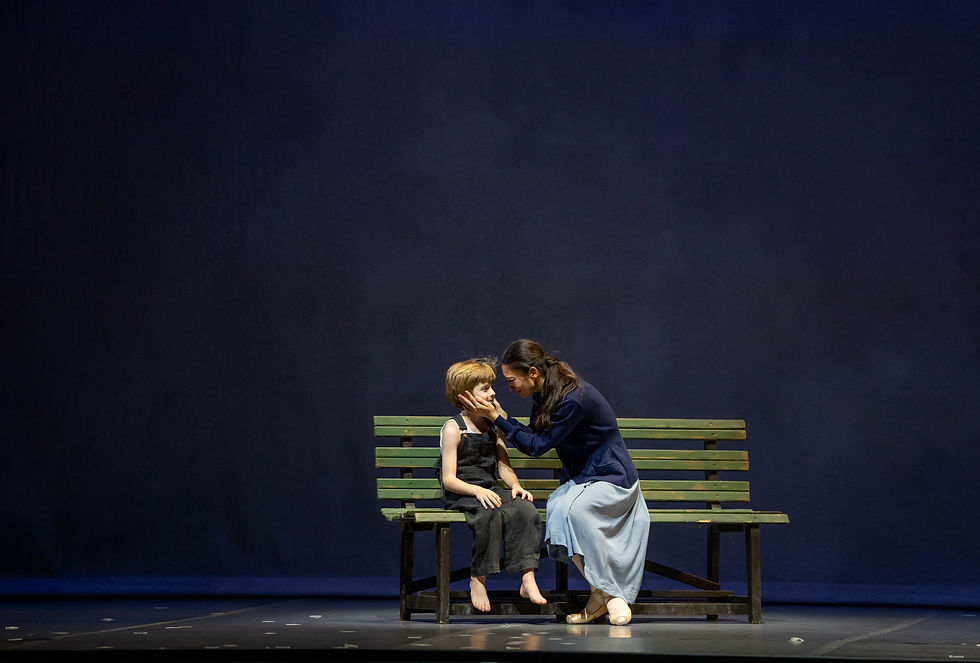
You can’t see the way that even as Liliom courts Julie, he doesn’t fully see her as a person. She tries to show him but he’s always turned away. You won’t know that he pulls away (literally) just as he gets close to anyone, and you won’t see his resistance to being vulnerable. You won’t see the moment he lets down his guard, curls into a fetal position on Julie’s lap, and her hand softly brushes his hair back.

You won’t see that love turn cold with a slap, and her life turn into an endless cycle of trying to clean up all the broken things, or the way that she ragdolls and melts in Liliom’s arms during their dances, but soars and leaps and enchants on her own, which he still doesn’t see. Or the way that caress comes back later on. Or the moment you physically see the violence spread through that familiar, beautiful but jarring pas de deux, to the last place you’d want it to. It’s in every single step on stage with every single performer.
It’s in the music, the symbolism of the balloons, the way Liliom peers from behind the veil to the life with Julie and his son he’s missing. It’s in the finer points of set design and the incredible costumes Neumeier designed.
You could’ve read the synopsis, but you didn’t have to read a single thing before you saw the Joffrey perform Liliom.
Why? Because Molnar’s words and Neumeier’s interpretations are carried by their feet, and the score, and the set. Every single thing comes together under the lights on that stage to tell a story of imperfect people, passion and loss that could come alive in no more realistic manner than this particular company’s portrayal, because they give it no less than everything in them. And I was hooked on every word left unspoken.


Comments